Creative visualisation – or, more simply, visualisation – is the practice of consciously focusing the imagination to support personal growth and transformation. It can be used to pre-experience your self-development, explore your inner world, and expand your sense of self and possibility.
In this post, I will discuss how visualisation – like Mindfulness and Meditation – can be used as a practice for Finding Your True Self. This is important because finding your True Self helps you connect with your inner truth and shape your personality in ways that feel more authentic and aligned, helping you live more authentically.
Visualisation and the Power of the Imagination
Visualisation harnesses one of the great, often untapped and underestimated powers: the imagination. Unfortunately, the imagination is often supplanted by received images from the mass media. Along with the heavy emphasis that socialisation places on the rational mind, this can lead to the atrophy of the imagination, relegating it to the passive consumption of entertainment rather than its use as a tool for personal development.
We are usually taught from a young age to mistrust the imagination and believe that it is foolish to give it any sense of reality. As children, we are encouraged to grow out of talking to imaginary friends, and we are led to believe that the imagination is not to be trusted and may lead to delusion and madness.
In doing so, we lose a certain freedom of spirit – for with imagination comes the freedom to explore who we are, to expand our potential, and to imagine different ways of living. Imagination allows us to dream and to break out of our reactive patterns that can reduce our humanity to little more than passive consumption. It allows us to be creative and to think outside the box. Imagination is therefore vital for self-development. It can also be a doorway to spiritual experience.
Visualisation is an important skill because, through the imagination, it can open you to new information and possibilities. Through your imagination, you can interact with the unconscious mind, often through the language of symbols, which can bridge the conscious and unconscious parts of your mind. When the rational mind is rigid and sceptical, the imagination can release important information to you symbolically that could otherwise be analysed away and rejected. This happens in dreams and can also occur in visualisation.
The key thing to realise is that the imagination is not only something you can direct; it can also act as a source of insight and power. Through visualisation, you can use it to guide yourself on an inner journey towards your True Self.
Visualisation can also be used in self-development for achieving outcomes. When you clearly visualise your intention taking form and experience the feeling of it happening, it becomes more likely to take shape in your actions and experience. It can also be used to support your sense of wellbeing when you visualise yourself returning to health. This kind of visualisation was famously used by Dr Simonton, the radiation oncologist who encouraged his cancer patients to use the power of positive imagery.
How to Practise Visualisation
Visualisation is a skill that improves with practice, and it works well alongside mindfulness and meditation. For instance, you can practise visualisation mindfully, keeping analytical thoughts at bay. You can also begin the visualisation from the inner space you cultivate in meditation, which can deepen the power of the visualisation.
When you use visualisation to find your True Self, it is important to hold a balance between conscious intention and free-form activity – the active and receptive modes of visualisation. Mindfulness can help you maintain this balance so you do not drift into daydreaming or lose your ability to guide your journey.
In the visualisations I teach, I begin by setting a clear intention for the visualisation and then begin a conscious inner journey related to that intention, often with specific milestones and features.
During that journey, I allow for imagery, impressions, and symbols to spontaneously arise to reveal information. At this stage, it is important not to let the rational mind jump in to analyse the meaning of the imagery, impressions, and symbols, for this will break the free flow of the visualisation and shift the brain into a less-conducive state for visualisation. Simply stay with the visualisation and interact with what appears.
For example, if a treasure chest appears, you can choose to open it and see what is inside; if you see a door, you can step through it and see what is beyond; and if you meet a being, you can communicate with it. Even though the practice is primarily visual, engage all of your senses. You may find your intuition becoming more active, and that communication with any characters or presences in your visualisation happens without words.
Visualisation is a great gift. To make the most of it, practise it regularly and treat it with equal importance to the other daily things you do.
Common Symbols in Visualisation
As a guide, I have included a small selection of universal symbols commonly associated with self‑realisation, along with their usual meanings, to support you in your visualisations. Remember that no symbol has only one interpretation; its meaning depends on the message of your own unconscious mind and the personal associations you already carry. As you deepen the connection between your conscious and unconscious mind, your ability to interpret these symbols will naturally strengthen. Even so, the interpretations offered below are often a helpful starting point.
- a wise teacher or sage: the True Self
- a sun, star, candle, or light: enlightenment
- a flower: the blossoming of potential
- a lotus: purity and spiritual awakening
- a rose: love
- a butterfly: transformation
- a circle: unity or completion
- a path or stairway: a journey of self-development or awareness
- a door: an opening to another reality, realm, or experience
- wild animals: passions and desires
- an obstacle: an inner resistance or blockage
Through the use of symbols, you can connect different levels of your mind and awareness, which can assist your spiritual development and spiritual awakening.
How to Prepare for a Visualisation
- Set aside some quiet time for your visualisation in a place that is free from distractions and interruptions.
- Adjust the temperature and lighting for your comfort if you are indoors; if you are outside in nature then find the most comfortable spot.
- Sit or lie down, whichever is the most comfortable. You do not have to maintain any special posture. If you choose to lie down there may be a greater chance of falling asleep. If so, sitting comfortably is preferable.
- Now set your intention for your visualisation. For example: I intend to discover more of my True Self through the power of visualisation.
Guided Visualisation to Find Your True Self
To give you a sense of how visualisation can help you find your True Self, I have created a guided visualisation for you to follow below. If you prefer the recorded audio on YouTube, you can click here. As you move through the practice, notice any images, impressions, or symbols that arise, and make a note of them – along with anything you felt or discovered – once you’ve finished.
Sit comfortably and close your eyes.
Allow any thoughts and tensions of the day to fall away.
Feel the muscles of your body relax as you let go of any physical tension.
Especially the muscles of the jaw and the eyes,
And any areas you notice that are more tense than others.
Feel each muscle relaxing as you let go of tension there.
Now focus on your breath as you breathe in and out,
Allowing it to flow smoothly,
Breathing in from infinity
And out to infinity.
Now recall your intention for the visualisation.
Allow it to carry you in your imagination to a safe and relaxing place in nature.
Take a moment to experience the beauty and power of this natural space with all your senses.
Breathe in the fresh air and smell the fragrances of nature.
Take in the sounds and hear the music of nature.
Use your skin to feel the textures of nature.
Look around and see the colours and shapes of nature.
Open your mouth and taste nature.
Move around your safe space and allow your energy to rejuvenate,
For you are realigning to your natural being.
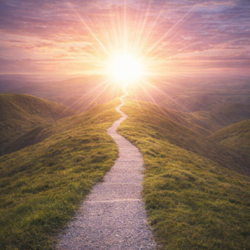
Now, as you look around, you see a path stretching ahead of you,
Leading off into the distance.
This is a reassuring and strangely familiar path.
You recognise it as the path you must walk to find your True Self.
In your own time, start to walk up the path, and notice your surroundings,
And anything that may appear to you.
You are gradually ascending as you walk along this path.
Very soon you will find yourself at the bottom of a big hill.
Waiting for you there is a friendly guide who seems to know you and greets you.
The guide explains that you must climb the hill to complete your journey,
And hands you everything you need to do this.
The guide takes you to a nearby well, where you drink of the purifying waters.
You bathe your face, forgetting all your worries and preoccupations.
Now you feel more clear and alive and ready to climb the hill.
You thank the guide, who embraces you and reminds you to believe in yourself.
As you climb upwards, become aware of the things on your path,
And any hurdles you need to overcome. Take a rest if you need to.
You remember the advice to believe in yourself, and this carries you upwards.
The sun is at its strongest overhead, and the higher you climb, the brighter it gets.
After a period of time, you near the summit, with anticipation,
And as you reach it, you find yourself in a beautiful, magical place.
Experience this beauty and magic, and absorb it into you.
This beauty and magic speaks of who you truly are.
Notice what is around you,
And how distant everything looks below you.
You wait in expectation, and after a while, a figure appears and approaches you.
You notice that the figure is a wise teacher or sage, and radiates peaceful light.
You recognise each other, for this is your True Self.
In a timeless moment, you greet this being,
And are reminded of all that you truly are.
Take this moment to ask your True Self what you most need to know
In order for you to be more yourself.
Your True Self may respond with words or by giving you a symbolic gift,
Or you may suddenly realise the answer.
If you do not get an immediate answer, know that it will come to you later,
Either internally or through the development of circumstances,
And simply absorb the presence of your True Self,
Which alone is enough to begin your transformation.
When the experience feels complete, express your gratitude to your True Self.
You both embrace as one, and then you make your way back down the hill,
Knowing that your True Self is always there when you intend it so.
Notice how you feel, and anything you encounter on your journey back.
As you reach the bottom you find your way back along the path,
To your safe space in nature.
Now set your intention to return back to your physical body,
And as you do so, feel yourself back in your body,
In the present moment,
And slowly open your eyes,
Feeling fully grounded and centred
And ready to greet the rest of the day
With greater presence,
Greater authenticity,
Greater wisdom,
Greater peace,
Greater compassion,
And greater gratitude for life.
Listen to the guided visualisation on YouTube.
Next Step: If this resonated with you and you would like to explore your True Self more deeply, you are welcome to book a Guidance Call.
Related Posts
The True Self
Finding Your True Self
A Meditation to Find Your True Self