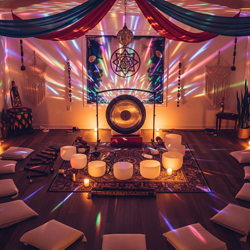

Spiritual community is a powerful catalyst for awakening, healing, and embodying our true selves. In a world that often suppresses our spiritual nature, these communities offer safe, heart-centred spaces where we can reconnect, grow, and thrive — both individually and collectively.
With mutual support and shared spiritual purpose, the best spiritual communities help us awaken to, embrace, and ground our true spiritual selves into physical reality. Rooted in mindfulness, compassion, and spiritual purpose, they empower us to embody our spiritual light and help create a more conscious and compassionate world.
In this post, you’ll discover the transformative power of spiritual community to meet both our spiritual and physical needs — and how it offers a healing alternative to the often destructive conformity of mainstream society.
We’ll explore the difference between transitional and autonomous spiritual communities, and how each supports your journey of spiritual self-realisation and collective transformation. Whether we’re seeking to connect, heal, or live more authentically, spiritual community provides a living model where our true selves can flourish with freedom — and where our lives becomes part of something greater.
Read on to discover how you can begin or deepen your journey into spiritual community — and why the world needs it now more than ever.
What is a Spiritual Community?
A spiritual community is a collective of individuals who come together in mutual support to grow, practise, and embody their spirituality in daily life. While spiritual communities take many forms, this post focuses on those devoted to the embodiment of the True Self and its light, while honouring all life as one sacred whole.
At the heart of this kind of community is a shared spiritual presence nurtured through mindfulness, heart-centred presence, and spiritual growth. Core values such as authenticity, compassion, peace, and freedom guide the community’s direction, while regular spiritual practice — including meditation, deep listening, and spiritual bonding within the community — anchors and strengthens this shared journey.
These communities offer the freedom and support each person needs to integrate the True Self into the personality, and to embody its light through grounded, consecrated action. They become a sanctuary where spiritual awakening can take root in the body and in the world.
Importantly, genuine spiritual community must also address physical needs in a spiritually integrative way. Fulfilling only our spiritual longings while outsourcing our physical needs to a society that demands the repression of the True Self and its values is counterproductive for spiritual self-realisation.
A truly transformative spiritual community understands this dilemma. It empowers its members to break free from spiritual compromise, and to embody a new, integrative model of living — one that meets both spiritual and physical needs without sacrifice. In doing so, it not only supports personal liberation but also becomes a living example of how society itself could evolve. This dedication to authenticity requires us to create a pathway out of adaptation to spiritually repressive societies.
Why Spiritual Community Matters Now More Than Ever
Spiritual community is a basic human need. It offers sanctuary, belonging, and authentic connection for those seeking deeper spiritual meaning, acceptance, and authentic connection. As fundamentally spiritual beings, we need spiritual community to affirm and express our true nature — and to collectively ground our spiritual values into the physical world. Only then can our lives, relationships, and society begin to reflect our spiritual light.
Spiritual Community is Needed for Recovery and Self-Realisation
Mainstream materialistic society drowns out the spirit and silently demands the repression of the True Self for us to adapt to it. In spiritual community, we can recover from this repression of the True Self and the silent trauma we have endured.
In spiritual community, we can rediscover, reclaim, and celebrate our true selves — in safety, affirmation, and shared spiritual values. We can be at our most vulnerable, connect heart-to-heart, and build a life rooted in authenticity and mutual support. Most importantly, spiritual community answers the call from deep within the True Self: to reconnect, remember, and honour our true spiritual nature in which we’re all connected in essential unity.
Why Repressing our True Spiritual Nature for Comfort is a Dangerous Dependency
Repressing our true spiritual nature in exchange for the comforts of materialistic society makes us dangerously dependent on a system that lacks a spiritual centre. Without a spiritual core, such a society evades spiritual accountability — allowing it to normalise desacralised, destructive behaviours and the suffering that follows.
Consider the cost of this repression:
- War and violence: Global conflicts escalate and are increasingly gamified, with little regard for human life — or the collective threat of annihilation.
- Mass media manipulation: News and entertainment spread and normalise fear, trauma, and disempowerment, distorting how we see the world and ourselves.
- Disempowerment: Power becomes more globally centralised, disempowering communities while individuals repress their inner spiritual power.
- Digital dissociation: Technology draws us into hypnotic screens and virtual realities that disconnect us from our spiritual nature.
- Digital control: The push to digitise every aspect of life gives unprecedented influence to algorithms and AI, which increasingly mediate and limit our choices.
Spiritual Community is a Collective Responsibility
In the face of these escalating challenges, the need for spiritual community is more pressing than ever. It’s our sacred responsibility to remember who we really are and to embody this fully.
Spiritual community empowers us to act on our spiritual values: peace, joy, compassion, gratitude, wisdom, truth, and freedom. When we take practical action in this way and embody our spiritual values fully in society, we change the world for the better.
Think about it: in what ways are any of these spiritual values currently driving mainstream society and setting people free to live as their true selves? Your answer to this question is the confirmation you need to break free from any cognitive dissonance and act now.
Overcoming Apathy and Action Paralysis
Apathy and action paralysis are major barriers to the emergence of spiritual community. Recognising and addressing these blocks is essential if we’re to move forward.
They often appear as negative beliefs—such as the idea that forming or joining a spiritual community is too difficult, unnecessary, unrealistic, hopeless, or in conflict with the preference for living life as a private individual. These beliefs represent inner resistances, distorted perceptions, or illusions that should be challenged for their cognitive distortions and then reframed as follows:
- It’s too difficult (maximisation). It’s not too difficult—spiritual communities already exist. The challenge lies in stepping out of our comfort zones and taking responsibility. With a committed vision, a positive mindset, and the right support network, we can overcome obstacles and make spiritual community a reality.
- It’s not strictly necessary (minimisation and filtering). From what viewpoint? Spiritual community is clearly necessary for us to be fully our true selves, live in a better world, and stop humanity from self-destructing.
- It’s unrealistic (jumping to conclusions, filtering, minimisation). It only seems unrealistic if we choose not to take action and make it happen. Spiritual community is a natural outgrowth of the True Self. Humanity creates plenty of spiritual communities, whether they are ecovillages, intentional communities, or traditional indigenous communities.
- It’s hopeless (jumping to conclusions, filtering, minimisation). There is hope. Enough spiritually conscious individuals exist to form spiritual communities, and the very act of building them restores hope. Humanity has always created spiritual communities—it’s part of our nature.
- It conflicts with the preference for living life as a private individual (jumping to conclusions, filtering). Authentic individuality is strengthened—not lost—within spiritual community. It’s mainstream conformity that suppresses individuality and the True Self, pushing people to retreat into privacy as a defence. In contrast, spiritual community honours and protects privacy as a vital aspect of wellbeing, balance, and self-reflection.
As I explore in Overcoming Apathy and Action Paralysis, mindfulness is the key to liberating ourselves from the negative beliefs and reactive patterns underlying apathy and action paralysis. Mindfulness increases our consciousness and liberates us from the automatic reactivity linked with apathy and action paralysis so we can consciously direct our attention, choose empowering thoughts, and cultivate a positive mindset.
To overcome apathy and action paralysis around developing spiritual community, we need to focus on the essential benefits of spiritual community and the urgent need for it. We can then create a positive vision from this, commit to it, and empower it daily with our attention and light.
Establish a Local Support Network and Action Group
It’s important to have a local support network of like-minded individuals dedicated to building spiritual community that also functions as an action group—helping to overcome isolation, apathy, and action paralysis through shared vision and collaboration. If no such group currently exists in your area, don’t wait for one to appear—reach out and initiate it. Ideally, form this network outside of corporate social media platforms so that it stands spiritually sovereign.
The purpose of this support network is to unite those who share common spiritual values and form an action group committed to the development of spiritual community. The practical steps of this development are further explored in the section “Building a Spiritual Community”.
The support network and action group should:
- Explore the essential benefits of spiritual community and the urgent need for it.
- Share ideas and perspectives on the True Self and how to develop as a spiritual community.
- Identify shared spiritual values and guiding principles to underpin spiritual community.
- Establish a shared spiritual vision and purpose.
- Agree on specific, measurable goals and action steps for building a spiritual community aligned with the group’s core spiritual values.
- Collaborate inclusively, with shared leadership and volunteering.
- Hold itself accountable for completing action steps and honouring commitments.
- Measure its progress towards achieving goals and adjust strategies as required, staying responsive to changing circumstances.
- Provide workshops and training sessions for learning and skill building.
- Commit to personal and spiritual growth through the process of spiritual community development.
- Organise regular social events and gatherings, including group meditations to stay spiritually attuned and connected as a group.
- Stay motivated, informed, and connected with group messaging, emails, calls, and newsletters.
Transitional Spiritual Communities
A transitional spiritual community is formed within mainstream society and marks a collective movement away from it and its norms. It evolves over time and serves as a guiding light to mainstream society as well as a “halfway house” between mainstream society and a fully autonomous spiritual community, evolving gradually as its members deepen their spiritual embodiment. Some transitional communities may ultimately become independent from mainstream society, while others remain semi-integrated but spiritually distinct.
In these communities, individuals engage in an ongoing process of disentangling from societal conditioning and aligning with spiritual truth. Through this journey, they learn to find and embody their true selves and begin manifesting their full potential. The focus is on establishing spiritual autonomy and authenticity. These individuals will often require recovery and healing from the destructive and repressive influences of mainstream society.
At the same time, these individuals, with a foot in both worlds, are in a perfect position to help mainstream society evolve. Through their interactions with others in mainstream society, they can share their True Selves, challenge repressive societal norms, and serve as spiritual guides for embodying the True Self and living in spiritual community.
To support this transition, such communities will explore autonomous and sustainable living practices with a focus on self-sufficiency. This includes:
- Developing self-sufficient lifestyles.
- Creating local economies and value exchange systems.
- Emphasising spiritual growth alongside practical autonomy.
- Honouring each individual’s healing and recovery journey from societal trauma.
- Providing a space for individuals to live together—or not—based on what best supports collective and personal wellbeing.
By embodying this model, transitional spiritual communities offer hope, guidance, and inspiration—lighting a path for others ready to step out of conformity and into conscious, connected living.
Autonomous Spiritual Communities
An autonomous spiritual community exists independently from mainstream societal structures. It’s formed with the conscious intent to live outside the cultural norms and influences of mainstream society, prioritising autonomy, self-governance, self-sufficiency, and spiritual self-realisation. Community members are committed to fully embodying the True Self and living by its spiritual values, rooted in mindfulness, compassion, and inner growth.
Individuals in this type of community may still go through the process of disentangling from mainstream societal norms and learning to find and embody their true selves. They may also require recovery and healing from the destructive and repressive effects of mainstream society, especially if they haven’t passed through a transitional spiritual community. They will live together on the same piece of land. The community provides a supportive container for this inner work to unfold in alignment with spiritual truth.
Autonomous spiritual communities offer an ideal model of authentic spiritual living—not only for their own members, but as an inspiration and blueprint for those in transitional communities and even for those still within mainstream society. These communities are rooted in:
- Spiritual embodiment as the foundation of daily life.
- Self-sufficient and sustainable living practices.
- Minimal dependency on external systems.
- A localised economy where products and services are exchanged within the community or between other autonomous spiritual communities.
While some exchanges with mainstream society will inevitably occur, the goal is to complete the transition to a spiritually aligned, sovereign way of living. These communities demonstrate what becomes possible when individuals come together with a shared commitment to truth, wholeness, and the evolution of consciousness.
Building a Spiritual Community: Vision, Structure, and Sustainable Living
A truly transformative spiritual community is built on shared spiritual vision and values, and grounded, intentional action. It doesn’t arise by accident. It grows from a conscious commitment to embody the True Self in daily life and to support each other in the integration of spiritual values into every aspect of living.
Spiritual Vision and Purpose
The community’s spiritual vision and purpose should include developing autonomy and providing mutual support for grounding the light of the True Self into physical form and honouring all life as sacred.
Guiding Principles
A spiritually aligned community thrives when its members commit to guiding principles that reflect spiritual maturity and collective responsibility:
- Mindfulness.
- Personal and spiritual growth.
- Personal responsibility.
- Authenticity.
- Embodied spirituality.
- Mutual support.
- Inclusivity.
- Respect.
- Compassionate relating.
- Conflict resolution.
- Collective decision-making.
- Autonomy.
- Sustainable living.
Shared Spiritual Values
Further guiding principles can be derived from the community’s shared spiritual values. Some key ones are:
- Peace.
- Joy.
- Compassion.
- Wisdom.
- Truth.
- Authenticity.
- Self-realisation.
- Wholeness.
- Freedom.
Community Size: Why Smaller is Stronger
In an intentional spiritual community, the number of individuals should be kept to a size that is practicable for consensus-based decision-making and enables individuals to interact, know each other as a whole, and bond socially. Dunbar’s Number suggests no more than 150 people, although the exact number will depend on circumstances.
Consensus-Based Decision-Making
Decisions that impact the whole community should be made by everyone through consensus. This ensures that the decisions made meet the needs of everyone as much as possible and are more stable.
Consensus-based decision-making requires all to be present and included as the community discusses, deliberates, and makes decisions. Any objections or concerns should be raised for further discussion to avoid groupthink and exclusion. A resolution of different viewpoints through discussion, deliberation, and the expansion of perspective enables everyone to reach agreement. In some cases, we may choose to support a decision even if it’s not our first choice, as long as our first choice was initially raised and we see no harm in going with our second choice.
Consensus-building is most effective in intentional spiritual community where there is deep bonding with shared values. To support consensus-building, we can also encourage:
- Active participation and presence.
- Open, mindful dialogue.
- Listening with empathy.
- Reframing limited beliefs or perceptions.
Leadership and Facilitation
Spiritual community rejects power hierarchies and the deliberately institutionalised apathy that protects them. Instead, it empowers both self-leadership and collective leadership. Facilitators — not rulers — guide the group through processes, maintain cohesion, and nurture spiritual and practical alignment.
Facilitators may:
- Motivate group participation.
- Facilitate discussion and decision-making processes.
- Support conflict resolution.
- Support personal and spiritual growth.
- Coordinate workshops, events, and group projects.
- Help decisions align with the community’s shared vision and values.
- Administer the community currency system.
- Represent the community externally, when needed.
Personal and Spiritual Growth
An intentional community catalyses personal and spiritual growth by encouraging mindfulness, personal responsibility, compassion, and the integration of the True Self. Through the integration of the True Self, we can more effectively embody the spiritual values that will help make the world a better place.
A spiritual community can support this through:
- Daily meditation sessions.
- Study groups and workshops.
- Mentorship programmes.
- Inner work and spiritual healing practices.
Without compassion, we can become desensitised to human suffering and societal norms and values can easily become dehumanising. Given this, spiritual communities have a sacred responsibility to model compassionate living.
Community Bonding
Connection grows when we gather with purpose and presence. Intentional bonding activities nurture the soul of the community:
- Shared meals and potlucks: encourage communal sharing, contribution, and conversation.
- Music and art collaborations: express emotion, expression, and connection.
- Seasonal festivals, celebrations, and ceremonies: enhance festivity, community spirit, and spiritual ties.
- Community meditations: promote collective mindfulness and a sense of spiritual unity.
- Talking circles (a talking piece is passed around to provide each person an opportunity to speak): foster understanding and inclusivity.
- Storytelling circles: deepen connections by fostering empathy and understanding.
- Gift circles: deepen community bonds by promoting generosity, heart-centredness, and mutual support.
- Tree-planting and community gardening: symbolic of growth that supports the whole.
Creating a Spiritually-Aligned Community Economy
For true autonomy, a spiritual community must develop its own regenerative economy tied to the community and rooted in service, abundance, and spiritual values — not exploitation, scarcity, or the manipulation of cravings. It’s an economy that meets our true needs.
Key components include:
- Internal community trading: fosters self-sufficiency, resourcefulness, and creativity and keeps wealth within the community.
- Local, interest-free, non-convertible community currencies: keeps the circulation of currency and wealth within the community, safeguarding the community’s economy, and builds mutual support. A good example is a mutual credit system in which there is no physical currency and everyone has an account that starts at zero and moves into a positive or negative balance as products and services are given and received, with an intention for the balance to return to zero. Units of currency can represent the value of the product or service or an hour of service.
- Bartering: the direct swap of goods or services between two individuals without the use of currency fosters a sense of reciprocity and interdependence and cultivates a spirit of cooperation and shared abundance.
- Gifting: providing goods or services as gifts without expectation of immediate reciprocity deepens community bonds, generosity, and mutual support. Gifting is often done within a gift circle.
- Shared Resources: these are collectively owned by the community, offering a sustainable solution that strengthens community spirit. Examples include community centres, community gardens, communal spaces, shared dining areas, shared housing, tools, utilities, libraries, transport vehicles, and financial resources for collective needs.
- Sustainability: focuses on small-scale economics, reduced, eco-friendly production and consumption, and reuse and recycling.
These systems support ecological harmony and reduce dependency on extractive economies. To further reduce their dependency on the economy of mainstream society, spiritual communities can network and trade with each other for mutual economic support. While a transitional spiritual community can use its local community currency in parallel with the national currency, it prioritises the use of the local community currency.
Benefits of Spiritual Community
- Spiritual growth and self-realisation.
- Spiritual belonging and acceptance.
- Shared values.
- Freedom to find, develop, and embody the True Self.
- Greater authenticity.
- Liberation from the repression of the True Self.
- A greater sense of life purpose and fulfilment.
- Mutual support.
- Community bonding.
- Enhanced personal growth.
- Enhanced wellbeing.
- Peaceful and compassionate living.
- Collective decision-making.
- A beacon of liberation to mainstream society.
Conclusion
Spiritual community, whether transitional or autonomous, is urgently needed as an alternative to mainstream society, which has long repressed the True Self and is now taking an increasingly dangerous course.
Spiritual community provides the vital connection and support we need to embody the True Self and ground its light and spiritual values into the physical world. It also serves as a liberating beacon to those in mainstream society, shining as an enlightened model of living and a pathway out of suffering.
Let’s not sit back any longer. It’s time for us to come together with a shared vision of a positive, alternative world — and to actively engage in establishing and developing spiritual community. In doing so, we can help change the collective course of humanity for the better.