
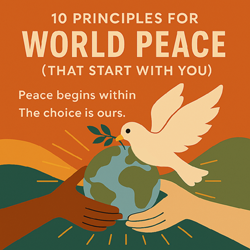
World peace is not just a dream. It begins with individual choices – and it starts within. Given the critical state of global affairs – wars, divisions, and rising reactivity – it is more important than ever to remember that peace begins with you and me – with all of us. This article is a practical call to action: not for passive hope, but for conscious, heart-centred action.
World peace is not some utopian ideal that we can only dream of. It may seem that way when expectations about world peace come from the same systems that give rise to conflict. Hoping for aggressors within deeply conditioned systems to champion peace, with no real change of consciousness within them or the systems that give rise to them, is wishful thinking.
In practice, world peace remains a real possibility, given the right conditions. It requires us all to safeguard our behaviour and our society, and to stop adapting uncritically to the systems that sustain conflict and war. This requires a positive change of consciousness and a willingness to move beyond passive acceptance, so that we can all contribute to making world peace a reality. World peace starts when we experience inner peace and cherish the beauty of life. It continues when we commit to this as a consistent standard expressed through our actions.
We are not alone. Almost everybody wants world peace, so we need only work together for this outcome.
World peace can be achieved when we all agree to honour the following ten principles of world peace.
10 Principles for World Peace
- World peace begins within. When we are inwardly at peace, we are far less likely to be at war. Inner peace means being free of the reactivity that breeds disrespect, resentment, hatred, aggression, violence, and conflict. Inner peace also means being at one with life.
- Anything that promotes the flourishing of life with compassion and awareness deserves our attention and support. Anything that promotes violence, death and destruction is anti-life and calls for a conscious withdrawal of our energy and support.
- Respect for life always facilitates peace and does not lead naturally to acts of war. We are all human beings sharing one planet. Together we have shared needs and a shared identity that deserves to be realised, respected, and made the foundation for world peace.
- When we respect all life, we can value both the differences and the commonalities. Valuing differences requires us to move beyond the assumption that the world should reflect only our own perspective from our conditioned point of view, or exists only to meet our needs.
- Each one of us shares the collective responsibility for world peace. Waiting for others to bring about world peace is an avoidance of responsibility, and will only perpetuate the tendency for war by diminishing the potential for peace. Peaceful thoughts and values need to be embodied in actions that contribute to world peace. Adapting uncritically to harmful social systems for comfort and not holding leaders to account for their aggressive and destructive behaviour is passive complicity. We all shape the world through what we do – and what we fail to do.
- Concentrating collective power in the hands of a few is dangerous. Allowing power to be concentrated in the hands of a few heightens the likelihood of power being misused or abused and increases its potential for destructiveness. It can expose populations of people to the intensity of that power, often expressed through powerful weaponry, which can be highly destructive on a global scale.
- You cannot force peace. Threats, wars of words, military strategies, and bombing others into submission are not peaceful and only mask the underlying hurts, tensions, conflicts, resentments, and mistrust that pose a constant threat to peace – revealing a world still at war.
- Developing compassion for others is essential. Putting ourselves in the shoes of others and connecting to our shared identity strengthens our desire to see others free from suffering.
- Gratitude for the blessings of life deepens our appreciation for peace because we value life. When we consciously cultivate gratitude for life and the peace that enables it to flourish, we will naturally want to uphold world peace.
- Mindful communication supports clearer understanding. By building emotional awareness and sensitivity, mindful communication promotes understanding of shared needs and differences upon which to build world peace without triggering reactive states in others.
What About Self-Defence?
How does self-defence from an aggressor fit into all this? To be clear, these principles are not a call for passivity or helplessness. They are addressed to all who perpetrate violence and to those who stand by and do nothing to stop it. We share a collective responsibility. We must all stay safe from aggressors and protect ourselves and our communities in a way that minimises suffering.
As we begin to act with greater mindfulness and compassion, inner peace and compassion can foster world peace, transforming aggressive societies into peaceful ones. We all have the power to uproot the causes of violence and fuel the growth of inner peace and compassion. Investing in a peaceful world is the most effective form of self-defence.
World Peace Starts Now – Not Later
We can begin by focusing on how we embody peace now, rather than perpetuating the patterns of conflict and violence through our acts of omission and commission. We can join with others in peace to reshape our personal lives, our communities, and our world. Let us not leave world peace until it is too late. And let us remember that we are all part of one world.